A white wall-mounted mini-split indoor unit near the ceiling of a dimly lit room, with a curtained window at right, a leafy potted plant at lower left, and a cushioned sofa at the bottom.

One request and it's handed off

Why your mini split has ice on it in a Wyoming winter

Ice on a mini split in a Wyoming winter usually means the outdoor unit is losing a battle it's built to win. Cold air shouldn't do this on its own. This page walks through what causes it and when it points to a real problem with the system rather than just the weather. Send the details below and let a local contractor who works on these units every winter take it from here.

Hand off my repair

Ice on the outdoor unit in winter usually means the defrost cycle isn't doing its job. Every mini split pulls frost on its coil when it's cold outside, that's normal, and the system is built to switch into defrost mode every so often to melt it off before running again. When you see ice building up and staying there, something is stopping that cycle: a stuck reversing valve, a failed sensor that tells the unit when to defrost, a fan motor running too slow, or low refrigerant charge. In Wyoming's cold, dry winters, that frost can build fast once defrost stops working, and a unit running iced over loses heat output and runs its compressor harder than it should. Left alone, it can damage the compressor outright. The fix depends on which part failed, and that's not something to diagnose by guesswork from inside the house.

A gray-haired man in a dark long-sleeve shirt sits on a gray sofa in a living room, looking toward a sunlit window with sheer curtains.
A gray-haired man in a dark green sweatshirt sits on a sofa in a living room, looking toward a bright window, with a houseplant, lamp, fireplace and framed art behind him.
A gray-haired bearded man in a dark green collared sweater sits on a sofa in a living room with a window, houseplant, floor lamp and bookshelves, looking off to the side.
A gray-haired man in a dark green sweater sits on a sofa in a sunlit living room, looking off to the side, with a framed landscape painting, dining table and shelving behind him.

Why does my mini split keep freezing up even though it's running fine?

It still heats the house, fans run, air comes out warm, but there's ice building up on the outdoor unit anyway. That makes it confusing. If something were broken, you'd expect the heat to suffer too. Since it doesn't, it's easy to assume the ice is just a cold-weather quirk you can ignore until it isn't.

The defrost cycle is running but not clearing the coil fully

A mini split can keep heating a room while the outdoor coil slowly loses the fight against frost. Defrost mode reverses the system for a few minutes to melt what's built up, then switches back to heating. If the outdoor fan is dragging, a sensor is reading wrong, or the reversing valve is slow to shift, defrost ends before the coil is actually clear. Each cycle leaves a little more ice behind than the last one melted. In a Wyoming winter, with long stretches well below freezing, that gap adds up fast. The house stays warm right up until the coil ices over enough to choke airflow, and that's when it stops being something you can watch and wait on.

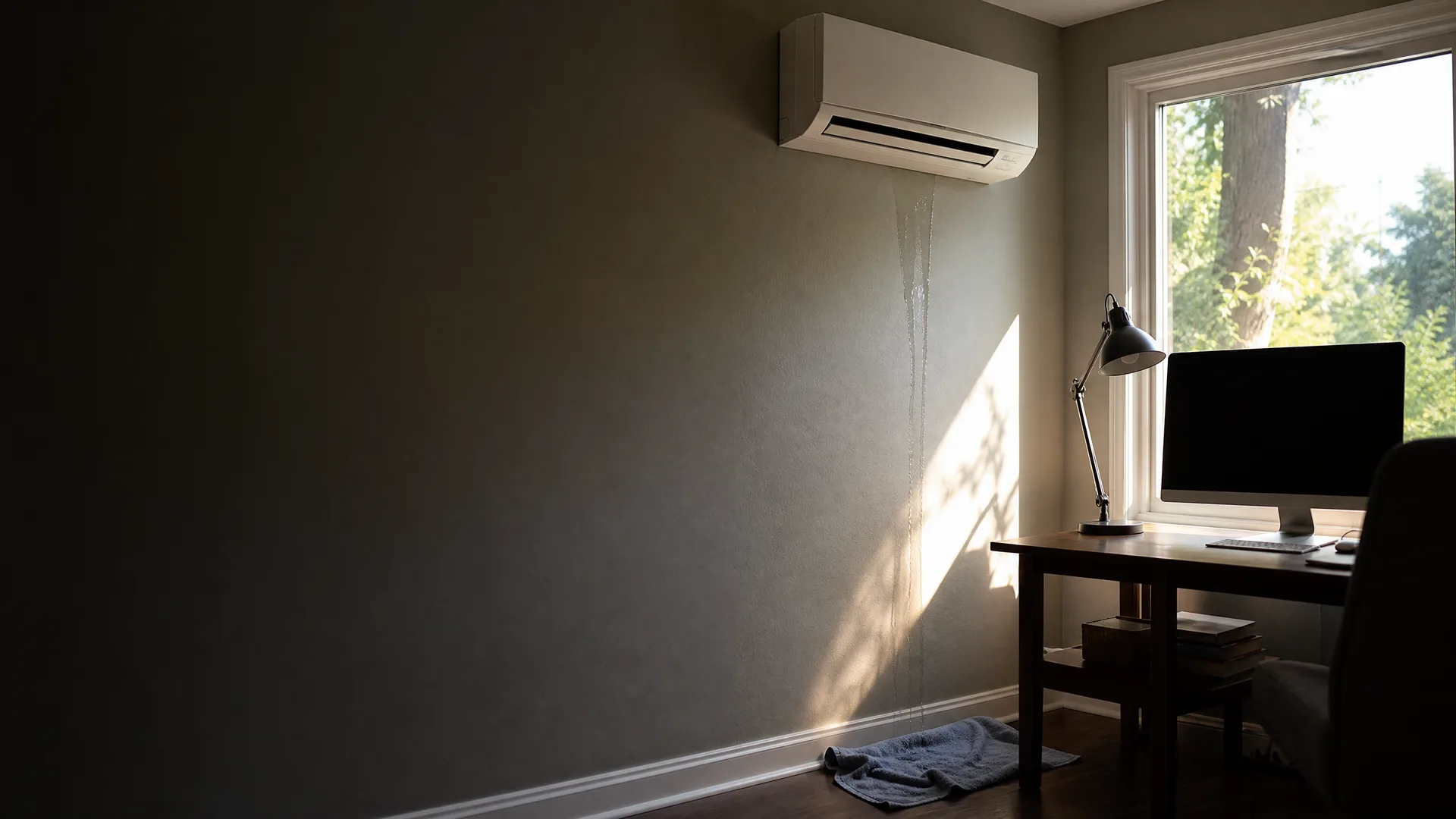
A wall-mounted mini-split air conditioner leaking water down a dim gray wall onto a towel on the floor, beside a window with a desk, lamp and monitor.

You're at the desk in the office in July, working through the afternoon heat, when you notice the wall under the mini split looks wrong. A streak of water is running down from the indoor unit, dark against the paint, and it's already reached the baseboard. You go grab a towel and lay it on the floor where the drip is landing. The unit is still blowing cold air, you can feel it from across the room, so the thing is working, it's just leaking while it does. Outside it's been dry and in the nineties for weeks. You stand there for a second looking at the wet patch, then go check if the towel is already soaked through.

A white wall-mounted mini-split air conditioner on a beige interior wall, next to a window with sheer white curtains and green foliage outside.
A thin, even coat of frost that disappears on its own once the defrost cycle kicks in is normal for a Wyoming winter.
A dusty, discolored wall-mounted mini-split air conditioner indoor unit on a plain white wall, with its horizontal louvers and vent grille visible.
Ice built up thick around the vents and caked with dust like this means the coil can't shed heat and the unit needs a look.

Power costs 13.37 cents per kilowatt-hour statewide

At 13.37 cents a kilowatt-hour, a mini split stuck in a bad defrost cycle doesn't run up the kind of bill that forces your hand. Here it can keep icing over quietly for weeks, since the power running the defrost heater or reversing valve barely shows up on the statement.

EIA-861 2025 statewide residential average

A white wall-mounted mini-split indoor unit installed high on a gray interior wall, with a sofa, dark table and window visible in an adjoining room to the right.

Running the way it should

A mini split that's defrosting right looks like this: steady airflow, no sound of strain, case clean. You might catch a thin line of frost on the outdoor coil some mornings, and it's gone within the hour. Nothing builds up on the housing or the vents.

A wall-mounted mini-split air conditioner indoor unit with a dusty beige casing and dark louvered vent, installed near the ceiling on a plain beige wall.

Something's keeping the ice on

Dust and yellowing on the casing like this usually mean the coil underneath has been fighting ice for a while, not just this week. When the unit can't shed heat through a dirty coil, frost sticks around instead of clearing, and it's worth having someone check why.

A woman with shoulder-length dark brown hair in a cream knit cardigan sits in an upholstered armchair beside a window, looking off to the side, with a white bookshelf and potted plant blurred behind her.
A woman and a child wrapped together in a thick knitted blanket on a sofa, both with eyes closed, with a lit table lamp and houseplant in the dim background.

Done looking for a mini split pro

A mini split that won't clear its own ice isn't something to watch through another cold snap. The defrost board, the sensor that tells it when to switch, the reversing valve itself, any of those can fail quietly, and most Wyoming homes don't have a backup when the one heat source in that room is down. Gas might carry the rest of the house, but if this unit is what heats the office or the addition, ice that keeps coming back is telling you it's losing that job a little more each week. Finding out which part failed usually means someone opening the unit, not guessing from inside. A contractor who works on these year-round in this kind of cold has seen which part in a unit like yours tends to go first, and that's faster than working it out room by room yourself. Send the details once and let someone who already knows this equipment take it from there.

What the ice is telling you

  • A thin coat of frost that melts off on its own during the defrost cycle is normal for a Wyoming winter.
  • Thick ice caked around the vents or built up on the case means the defrost cycle has stopped doing its job.
  • Left alone, a failed defrost board, sensor or reversing valve won't fix itself and the ice will keep coming back.
  • A local contractor who services mini splits all winter knows which of those parts tends to go first on these units.
  • Sending one request puts you with one licensed contractor in Wyoming instead of a pile of calls to sort through.
  • Once that request is in, finding someone to look at the unit stops being something you have to manage.

A little frost on the outdoor unit some winter mornings is just the coil doing what it's built to do. It melts off on its own and you move on with your day. Thick ice packed into the vents or built up on the case is a different thing. That's the defrost cycle not finishing its job, and nothing about a Wyoming winter fixes that on its own. The cold doesn't let up long enough for ice like that to just go away.

Whatever's behind it, a failed board, a bad sensor, a reversing valve stuck where it shouldn't be, it's a part that needs replacing or repairing, not something that resets itself overnight. The unit will keep pulling frost and keep failing to clear it until someone gets into the system and finds which part quit.

That's the kind of thing a contractor who works on mini splits all winter in this state has seen before, more than once, on units like yours. They know which part on these systems tends to go first, because they've pulled enough of them apart to know. Send one request and you're not stuck sorting through a stack of calls from companies you don't know anything about. You're put with one licensed contractor local to Wyoming, someone who can actually get eyes on the unit. After that, it's not your job anymore to track down who's available or who knows what they're doing. That part is handled.

A single-story stone-clad house with low-voltage path lights along a gravel bed and lawn at dusk, with a tree line and orange sky on the horizon.

Mini Split Repair

It's off your list after this

Step 1 of 3: Equipment
  • A cream upholstered armchair with a textured pillow sits in a corner beside a small round wooden side table holding a vase of greenery and a book, under a framed landscape print, with a potted tree in a woven basket and a sheer curtain nearby.
    • Tell a local repair pro what your mini split is doing.
    • Say what's going on with your mini split, and a pro who works on them reaches out.
  • A beige upholstered armchair with a green cushion and knitted fringed throw sits in a corner beside a wooden side table holding a stone vase of leafy branches, under a framed landscape picture, on a woven rug near a sheer curtain.
    • After this form, you can stop searching for a mini split pro.
    • One request and the search for a pro is handled.
  • A wood-framed armchair with light beige upholstery and a gray linen cushion sits in a corner beside a potted olive-like tree and a sheer curtain at a window, with a framed picture on the wall above.
    • Skip searching for a mini split pro and answer a few questions instead.
    • One form replaces the calls you'd make to find a mini split pro.
  • A ceramic vase holding leafy branches sits on a round wooden side table beside a sofa with a dark green cushion and gray throw, next to a sunlit window.
    • Your request stays with one local pro.
    • Your request goes to one pro, not a list of companies.